Tattoo Removal with Laser

gentle, precise, and effective

Some designs have lost their meaning; others are simply no longer to one’s taste, or perhaps they didn’t turn out as hoped. In some cases, you might just want an old tattoo to fade so that there is room for a new one. At our practice by the Stadtpark, we remove tattoos using state-of-the-art laser technology—session by session—without placing unnecessary stress on the skin.

How laser tattoo removal works

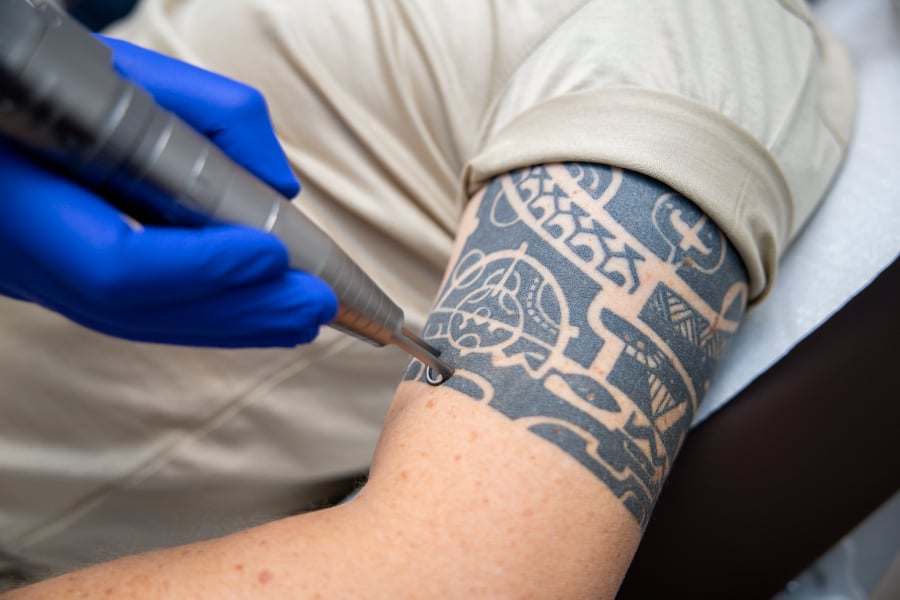
The laser delivers ultra-short, high-energy light pulses into the skin. The tattoo ink absorbs this energy, causing it to break down into tiny particles. Your immune system then removes these fragments via the lymphatic system. Consequently, the tattoo fades further with each subsequent session.

Since the laser targets the ink pigments specifically, the surrounding tissue remains largely unaffected.

For this procedure, we use the Spectra laser by Lutronic. It operates with multiple wavelengths, allowing it to be adjusted to suit different tattoo ink colors.

Which tattoos can be treated?

  • Professional tattoos, as well as those done by amateurs or self-inflicted tattoos
  • Black, dark blue, and dark gray—these colors respond best to treatment
  • Various other shades, such as red, orange, or brown
  • Permanent make-up, for example on the eyebrows
  • Specific parts of a design, if only a certain area needs to be removed
  • Lightening as preparation for a cover-up or a new design

Your benefits at a glance

  • Targeted: The laser acts on the color pigments, while the surrounding skin remains unaffected.
  • Precise: Specific areas or even fine details can be treated.
  • Time-efficient: Depending on the size of the area, a treatment can often be completed in just a few minutes.
  • Medically supervised: Personalized consultation and treatment.

The tattoo removal process, step by step

  1. Consultation: We will examine your tattoo closely—considering its size, colors, age, and ink depth—to discuss what is realistically achievable and how many sessions you should expect.
  2. Skin preparation: The area will be cleaned and, if necessary, cooled or treated with a numbing cream.
  3. Laser treatment: Laser pulses are applied point by point across the design. Many people describe the sensation as being snapped by a rubber band.
  4. Cooling and aftercare: Afterward, the skin is cooled and covered with a wound-care dressing.
  5. At-home care: You will be provided with detailed instructions to follow over the coming days.

After the treatment

Immediately after the laser treatment, the skin may appear white for a short time. Redness, mild swelling, and a sensation of warmth are normal and typically subside within a few days. Occasionally, small blisters or scabs may form; please leave these undisturbed so that they can heal properly.

Between sessions, your body continues to work: it gradually breaks down the fragmented ink particles, causing the tattoo to fade.

Be sure to consistently protect the treated area from the sun. Additionally, avoid saunas, swimming pools, and strenuous exercise during the first few days.

How many sessions are necessary?

There is no one-size-fits-all answer. Key factors include the color, quantity, and depth of the pigments, the age of the tattoo, the area of ​​the body, and your skin type. In most cases, multiple sessions—often 5 to 10—are required, spaced approximately 6 to 8 weeks apart. This interval is necessary to allow the skin to recover and for the body to flush out the remaining ink particles.

We will provide an initial assessment during your consultation.
Frequently Asked Questions About Laser Tattoo Removal

It is noticeable, but most people find it easy to bear. The feeling can be significantly reduced with cooling or an anesthetic cream.

Many tattoos can be removed completely or almost completely. It becomes more difficult with colors such as green, light blue, yellow, and white, as well as with designs that are very densely inked. No reputable professional can guarantee a completely residue-free result. We will be upfront with you about what you can expect.

When performed professionally and followed by proper aftercare, the risk is low. However, scars that formed during the tattooing process may remain visible.

Yes. Often, a design is deliberately faded so that it can subsequently be covered up with a new tattoo (a “cover-up”).

For example, during pregnancy or breastfeeding, in the presence of a fresh suntan, if there is acute skin inflammation in the area to be treated, or while taking medications that increase photosensitivity. We will clarify this with you beforehand during a consultation.

The price depends on the size and type of the tattoo, as well as the number of sessions required. You will receive a personalized quote following your consultation.

Schedule your appointment

for a detailed consultation